


2013-06-21
From a king to another
Usain Bolt is in Europe for new contests. Usain Bolt is the fastest man alive, but he is also a big football fan. Before one of his competitions he gest a signed shirt from Sweden, a gift signed by Zlatan Ibrahimovic. "From Zlatan? Wow," sais Bolt, and sends a greeting back.

Zlatan Ibrahimovic killed the Faroe Islands with two goals and three new fixed points for Sweden in the World Cup qualifiers. Then he sat down with his shirt and a marker pen. Zlatan wrote: "To the fastest man in the world - Usain Bolt". Usain Bolt was very happy when he saw the gift from Zlatan Ibrahimovic. Bolt has a great football interest and favorite football team is Manchester United. Therefore, he reacts strongly when present reporters syas that the latest rumor is that Zlatan is on his way to Chelsea - United's rivals - to reunite with manager Jose Mourinho (who was Zlatan's coach during the last days of the Inter). Bolt startled and says, "That's not good! Zlatan is one of the best players in the world and he must not go to one of our competitors. I love watching Zlatan play. He is a master."

He then takes a football in his hands. And a pen. Then he takes the opportunity to respond Zlatan. Bolt first put there his autograph. Then he smiles a little clever and writes: "To the best. From the best." The reporters ask: Are there any similarities between Bolt and Zlatan? Bolst replies: "Yes. Both are kings."
2013-06-20
The Panama Canal gets competition
Nicaraguan Parliament approved the agreement with a Chinese company that will design, build and operate for 50 years a rival to the Panama Canal. The order also includes two free trade zones, a railway, an oil pipeline and an airport. With a vote of 61 to 25 were approved by the history of the world's largest construction project - if it gets off.

For a minority share of any profits gives Nicaraguan Parliament, the Hong Kong-based company HK Nicaragua Canal Development Investment exclusive rights to the project and, if possible, build and operate a waterway between the Pacific and Atlantic which in that case will be a competitor to the Panama Canal about 60 mil to the southeast. President Daniel Ortega and his sandinistregering hope that the channel will give the economy a much needed boost, with tens of thousands of new jobs.
2013-06-19
Mapping billions of Tweets around the world
Ever wonder what it would look like to plot every single geotagged tweet since 2009 on a map? Twitter has done just that…They use billions of geotagged tweets: Every dot represents a tweet, with the brighter colors showing a higher concentration of tweets.

Visualizing the fight against poverty. Submit your best development data viz by clicking on the pencil icon on the right. check your region here: http://worldbank.tumblr.com/day/2013/06/11/
2013-06-18
WCO/SACU Regional IT Connectivity Conference 2013
Representatives of the SACU member states recently met in Johannesburg to progress developments concerning IT Connectivity and Customs-to-Customs data exchange in the region. The session served as a follow up to the session held last year in February 2012 in Pretoria. The conference was convened by the SACU secretariat under the sponsorship of the Swedish International Development Agency (SIDA), and was once again pleased to have SP Sahu, senior technical expert from the World Customs Organisation, to facilitate the work session over 3 days.

Representatives of UNCTAD ASYCUDA were also in attendance to observe developments. UNCTAD currently supports three (soon to be four) of the five SACU Customs administrations. The session provided an opportunity for delegates to progress this work as well as develop a terms of reference for an independent assessment of the two connectivity pilot projects that are currently being pursued between Botswana-Namibia and South Africa-Swaziland, respectively. IT Connectivity serves as a catalyst for various customs-to-customs cooperation initiatives seeking to bring about a seamless end-to-end flow of information between point of departure and destination. Some examples include export/transit data exchange, approved economic operator, commercial fraud, eATA and at least 5 other key areas of customs mutual exchange. The concept is driven out of the newly establish WCO model known as Globally Networked Customs (GNC). GNC was formally adopted by the WCO Council in June 2012 where a capacity building approach based on protocols, standards and guidelines (PSG) using utility blocks was recognised to provide the most realistic means to achieve efficiency gains, and a more effective way to manage the negotiation of international agreements between customs administrations.
There exist several pilot projects across the globe wherein customs agreements are being piloted under the GNC approach. Development of a Utility Block and supporting data clusters for interconnectivity within SACU and the broader Southern Africa sub-region already commenced at last year’s session. The concept gained sufficient traction and was soon adopted by both SACU and SADC member states as the means to implementing IT connectivity within the respective regions. A review of the Utility Block and data clusters was conducted to ensure alignment of customs data requirements across the member states. The resulting product now provides a standard ‘data set’ which members agree as the minimum data required to facilitate data exchange and advance risk management needs. It covers export and transit declaration requirements. Two important criteria exist for successful data exchange and data matching. The first being the availability of appropriate legal provision for two countries to exchange data. The second requires the use of an agreed unique identifier. The identifier is important for Customs as well as the trade community. Delegates were also presented with current and future developments occurring at the WCO, in particular the on-going work being done to formalise standards for the “My Information Package” concept as well as the WCO Data Model, currently at version 3.3. Another interesting on-going development involves a unique Trader ID.
Member states involved in respective pilot programmes are now preparing themselves for an up-coming evaluation, later this year.
2013-06-17
Africa is a great
Swedish world famous photographer, Jens Assur, has spent his last year in documenting the new Africa. He writes about the response he has received from his exibition, That has been displyed recently in Stockholm.

"During the spring, the Chilean-American artist Alfredo Jaar has exhibited at Malmö Konsthall. Jaar has a special interest in the Western world view of Africa. One of his works," From Time to Time, "is built of nine of the news magazine Times front pages. Sex of them showing starving and diseased children, three allows us to meet exotic animals. Inhuman hell or naturalist's paradise. Africa hold more pictures, more realities than that., it is JAARS points. has also been the starting point for my own project "Africa is a Great Country "where" country "naturally is said ironically. During almost a year I have photographed African capitals, a fast growing modern and urban Africa.

I am the first to state that, in addition to this there are many other Africa Africa - tormented by war, poverty, disease, corruption ... But the Africa I have documented are also available. As then head of the British charity Oxfam, Barbara Stocking, stated in an interview with the BBC last year, likely an African who unilaterally made to despair original home on earth will be an Africa that the outside world does not engage in. We must affirm the continent's diversity and complexity, said Stocking. After nearly two months old have been shown to Liljevalchs to have my exhibition "Africa is a Great Country" (the word "country" should be understood here as irony) now launched a comprehensive tour of Sweden. interest so far has been overwhelming. We expect about 200 000 Swedes will have seen the exhibition once the tour ends in autumn 2014. Ideally, they also brought with them a continued curiosity about what is happening, or does not occur, one of the world's most complex continents. too, the media, interest in "Africa is a Great Country," and the issues that are driving, been great. One example of many is that Aftonbladet now allowed a critical post about the exhibition serve as an introduction to a discussion on "the new Africa." That's great.
Some observers evokes an image of a more authentic Africa characterized by human warmth and fellowship, an Africa "which is full of life." This contrasts with the Africa that I blazoned, a western Africa of "things and finish." Maybe I need not even say that he thus joins a classic colonialist mindsets: Africans remain happiest if they can live as they always lived and not have to carry the white man's burden: ie do not have "plagued" by espresso bars, economic growth and functioning infrastructures. What some do not understand, or accept, is that the images are an artistic and political portrait of the everyday that 40 percent of Africans now live in one of the continent's fast-growing cities are a natural part of and where was the third belongs to the middle class. To quote Richard Dowden, Director General of British Africa Institute and regarded as one of the world's premier African connoisseur: "I think for many people Jens' pictures will be truly shocking. They show a dynamic, ambitious, thriving, ordinary Africa. "Or, as one of Africa's leading politicians, Nkosazana Dlamini-Zuma, the African Union's first female president and former minister in three South African Government caller said after the inauguration:" What did I think about the exhibition? I felt at home."
2013-06-16
The top ten goals of all times
Brittish Newspaper Daily Mail has announced the ten best football goals ever in the history of the sport. It is legendary reporter, John Motson that has made the selection.

In more than 35 years covering international football for the BBC, John Motson has seen 200 matches and been to 10 World Cups. Who better then to place Zlatan Ibrahimovic’s wonder goal in the context of some of the great strikes we have seen over the years. Here, Motson reveals Dialy Mails top 10 international goals of all time.
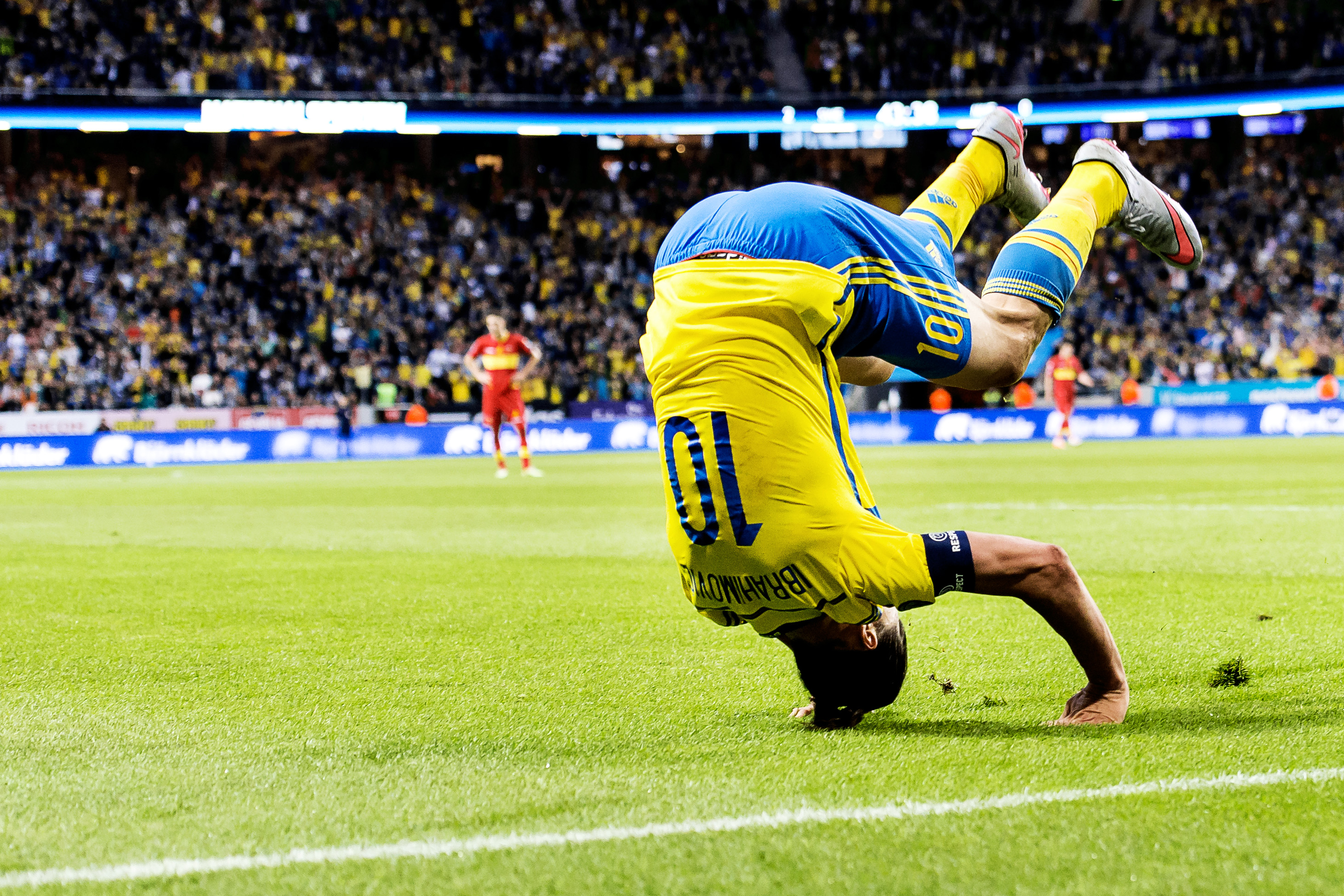
1 ZLATAN IBRAHIMOVIC v England, November 2012
It was spontaneous, out of this world, unexpected and athletic — the best I have ever seen. It was a sensational piece of improvisation and even more special seeing as he produced it in his country’s new stadium. It was the icing on the cake to a fantastic performance.

2 DIEGO MARADONA v England, 1986 World Cup
The Hand of God a few minutes before is the more talked about but Maradona’s second goal in that game runs Ibrahimovic close. Picking the ball up under pressure in his own half, he beat five England players before sliding the it home. Truly sensational.
3 CARLOS ALBERTO v Italy, 1970 World Cup
One of the greatest in the history of the World Cup and he did it in the final too. This was not a brilliant individual effort but a sublime team goal, a series of wonderful passes finished with a drilled right-foot shot from Carlos Alberto from just inside the area.
4 MARCO VAN BASTEN v Russia, 1988 European Championships
Another goal from a final but this was all about individual brilliance. From the tightest of angles, Van Basten blasted a stunning volley past Rinat Dasayev in the Russia goal. The angle looked impossible but a great player proved it was anything but.
5 PAUL GASCOIGNE v Scotland, 1996 European Championships
There were plenty of question marks over whether Gazza should have been in the England squad but Terry Venables stuck by him and it paid off. As the ball landed to him outside the Scotland penalty area, Gazza flicked the ball over the hapless Colin Hendry and volleyed in England’s second goal. Cue the dentist chair celebrations.
6 MICHEL PLATINI v Portugal, 1984 European Championships
Another man who was an inspiration on home soil. Platini finished off a wonderful French move with a minute to go in extra time after Jean Tigana beat three men and crossed for him. It won the semi-final.
7 DAVID BECKHAM v Greece, World Cup Qualifier 2001
With England struggling to qualify for the 2002 World Cup, up stepped David Beckham on his Old Trafford home ground for the finest moment of his England career. Everyone knew that free-kick was going in. He rose to the occasion.
8 ROBERTO BAGGIO v Czechoslovakia, 1990 World Cup
Baggio was Italy’s darling heading into the World Cup and he lit up the tournament against the Czechs. Picking up the ball in his own half, he played a one-two before dancing through to the box and sliding the ball home. It cemented his status as an iconic figure.
9 JOHN BOSMAN v England, 1988
Yes, it was a friendly but Wembley was treated to one of its greatest goals when Bosman headed in after a 24-pass move. The game finished 2-2 but will be forever remembered for a perfect team goal.
10 GEOFF HURST v West Germany, 1966 World Cup
How can an Englishman write a list without Hurst’s final goal on it? It is THE goal in England’s history and it’s often overlooked that it was a very good finish too. A fine strike.
2013-06-15
Rosling says to companies: Pay your tax in developing countries
Research organizations Swedwatch and Diakonia, which audit and checks aid agencies, have examined corporate behavior in developing countries. An example they have examined is Zambia. The country is badly affected by tax evasion, which according to a report costing the developing world 5000 billion each year. A sum that is far greater than all the world's assistance to these countries. In many cases, these are large companies that utilize loophole options to minimize tax.

For competitive reasons, the companies don’t want to disclose how much tax they pay in the country. But all say they follow the OECD guidelines. Professor Hans Rosling, a legend in the area, has long questioned the companies' work with responsible and sustainable Corporate Social Responsibility (CSR). "CSR is no more important? There's so little money, almost nothing. They should manage their business so well that they are profitable and in order to provide good wages, good products and good returns and pay taxes. Then you a good business and those we respect, "he says to Di.
2013-06-14
China - Tanzania Cooperation
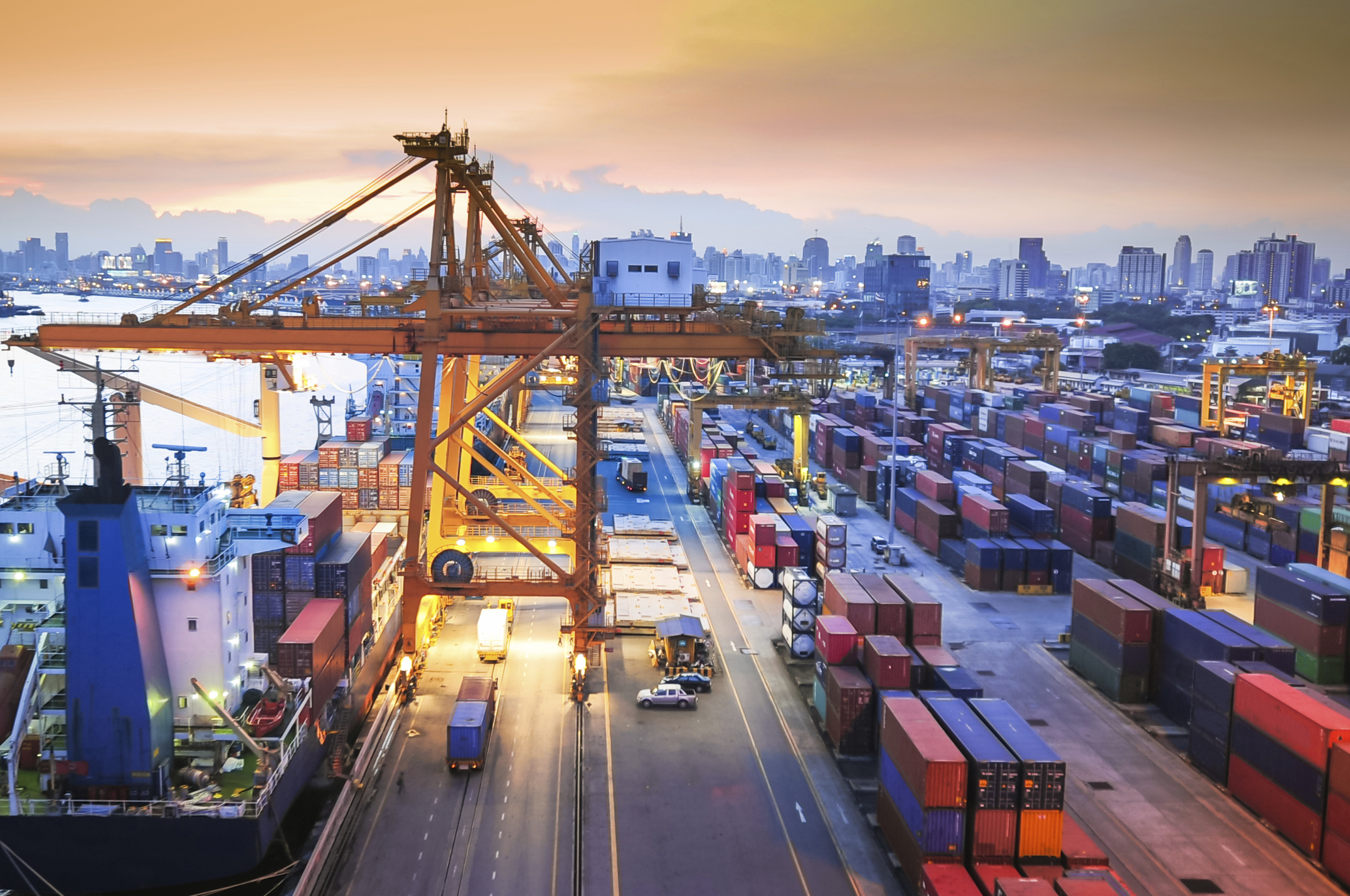
The Chinese President has sealed Tanzania’s Bagamoyo project. Tanzania has laid down its claim for a future large slice of regional trade through a deal with China to build the new port of Bagamoyo in its Mbegani area, north west of Dar es Salaam, at a total cost of $10bn.

The deal was announced by the President of China, Xi Jinping, while recently visiting Dar es Salaam and forms part of a major investment by the China in the infrastructure of the Mbegani area and East African seaboard – a project to be completed by 2028 with the expectation that Bagamoyo port will supersede Dar es Salaam port as the country’s main port and container handling centre. The new port will be built with a draft sufficient to accommodate higher capacity container vessels up to 10,000 teu and beyond, as well as possess specialised roll-on roll-off berths and other cargo berths. The overall scale of the planned development is such that it will provide a highly competitive solution to Kenya’s port expansion plans in Mombasa and Lamu which, as well as catering for national trade, are focused on meeting the needs of surrounding landlocked countries such as Uganda, Rwanda and Burundi. Kenya has ground out plans for a new deep water container terminal in Mombasa – now under construction – and has embarked upon major new port development at Lamu, but the Bagamoyo port plan has a stronger profile and coherence to it. The money is down and in the background are new offshore gas discoveries for Tanzania which promise to play their part in promoting a strong and enduring relationship with China. The first-phase development of Bagamoyo port is expected to be in operation by 2017 with construction undertaken by China Merchant Holdings of Hong Kong. There has been no discussion to-date of whether the new port will feature cargo handling terminals operated by the private or public sector. As in Kenya, this subject remains something of a ‘hot potato’ with some Tanzania Port Authority executives suggesting it was a mistake to introduce the private sector as the operator of the Dar es Salaam Container Terminal. As in Mombasa, there is a belief that the public sector could have done as well as private interests in seeking to achieve efficient container terminal operation. This belief persists in certain circles despite the TPA taking steps to raise the calibre of executives in its organisation through the introduction of executives from the private sector and a greater overall focus on human resources. Dar es Salaam currently handles over 9m tons of cargo per year which is equivalent to about 95% of all Tanzania’s import and export volumes. In container trade alone, growth has been over 12% per annum since 2000. Despite this, the cost of shipping to Tanzania is about 25% higher than rates to the larger competing ports in southern Africa. This is mostly attributable to port inefficiencies brought about by inadequate investment in port infrastructure. These costs are compounded when the effects of congestion and delay are added to the total freight bill, which can account for between 20%-70% of the total delivered price, inflating the price of imports and undermining global and regional export competitiveness. The rationale for the introduction of major new port capacity in Tanzania is self-evident – demand is outstripping available capacity. It is to be hoped, however, that new capacity will be introduced supported by a modern port management model and institutional arrangements to facilitate optimum use of this capacity at the lowest cost. Source: PortTechnology.com
2013-06-13
Sweden is a candidate for the UNESCO Executive Board for the period 2013-2017
In keeping with a long tradition, this is a joint candidacy of the Nordic Member States - Denmark, Finland, Iceland, Norway and Sweden - and Associate Member the Faroe Islands.

The Government of Sweden presents its candidature for a seat on the Executive Board for the period 2013-2017. The candidature reflects the engagement of the Swedish Government to participate actively in the process of reforms that the Organisation is carrying out to concentrate its functions and initiatives for better responding to the needs of the Member States and the global challenges
2013-06-12
Better broadband is the Capacity Building future
For low and middle income countries every 10% increase in broadband accelerated growth by 1.38%, says WorldBank in a new report. These are sensational numbers that really makes you think.
2013-06-12
Sweden won 2-0
Sweden beat the Faroe Islands 2-0 in their World Cup qualifier in Stockholm, Tuesday, to move level on points with Ireland and Austria in Group C. Captain Zlatan Ibrahimovic led by example, scoring both goals for Sweden, who had defender Andreas Granqvist sent-off late on.

Ibrahimovic opened the scoring in the 35th minute and added a second from the penalty spot with eight minutes remaining. The Paris Saint-Germain striker was also lucky to avoid a booking which would have ruled him out of September's crucial qualifier against Ireland in Dublin.
The Swedish striker was upset by the constant complaining of the visitors to the referee and threw a ball into the face of goalkeeper Gunnar Nielsen which would have earned him a yellow card if the referee had seen it.
Erik Hamrén's side have 11 points from six games, level with Ireland and Austria as the battle for second spot and qualification for the World Cup in Brazil hots up. Austria lie second behind Germany due to their eight goal advantage over Sweden in third.
2013-06-11
High-Level Workshop in Kathmandu
Today I was doing a high-level workshop about the new National single Window and National trade portal that we, KGH Border Srvcies, are developing for Nepal Government.

The workshop was conducted for senior officials from Nepal Government agencies. We hade very good participation and many good proposals and suggestions during the workshop. I really like working with collegaues from another country like this. It is indeed very rewarding. Good discussions in the way forward.
2013-06-10
The age of Social Media is here
Not long ago social kedia, like e.g Facebook, Tumbler and the microblog Twitter, were only for private networking. There were specific, similar professional networks like e.g LinkedIn, where people could connect. Today more and more organizations, both private and public, are using social media as an important part if their communication strategies.

This is the future. Today there are 1 billion Internet users in Asia alone and 175 million fo them have Facebook accounts. This is naturally our clients anf Facebook, as well as Twitter, are excellent places to market and communicate our business, information and messages to the public. It is also a new channel to post our legislation, rules, procedures and guidelines. In addition it is maybe the best channel for interaction with these people. we have not seen nothing yet. Social media is here to stay, not only as personal networks but also as professional networks, used in our day-to-day working lives, regardless if work in private or public sector.
2013-06-09
In Kathmandu again
I have arrived to the beautiful city of Kathmandu in the Himalaya.

It is great to be back. I really like the people here. It is also great to see the progress on the ground and to be able to deliver practical advice leading to successful results. We have an operational office on the ground in Kathmandu for this project. The office has a office manager from Malaysia and staff from Nepal. We also work with a number of very good Nepalese experts.
2013-06-09
Sweden lost against Austria
Sweden on Friday played a good game, much better than the last one against Republic of Ireland (0-0), against Austria away in the FIFA World Cup 2014 qualifying group round. This was our first loss in the on-going round of games in the group qualifying stages of the tournament. Sweden played very well the first 30 minutes and had 3-4 qualified opportunities to score.

Instead an individual mistake of one of our defenders causing the goalkeeper to dive in front of an Austrian player that got a free pass towards the goal. The referee made the decision to award a penalty for Austria. This was unlucky since Sweden was denied a clear penalty in the beginning of the game, but that is sport. Just after the penalty goal, Austria score a second goal on counter attack. In the second half Zlatan Ibrahimovic with a brilliant pass gave Johan Elmander an open goal for the 1-2 score. Then Sweden attacked for another 25 minutes with many chances to score but without succeeding. We were also denied another two penalities in the end minutes of the game. We were very unlucky this time. Now it is an open race between Sweden, Republic of Ireland and Austria to grab the play-off spot. We play Austria at home and Ireland away.
2013-06-08
On my way to Nepal
It is time to do another trip to Nepal for project work. We are doing the National Single Window and the Natonal Trade Portal for Nepal Government.

The project is done together with one of our partners. Next week we will have a number of meetings and also four high-level workshops about Change Management and Capacity Building.
2013-06-08
Why Sweden has riots
By Johan Norberg
All of them should have been very happy,’ Robert A. Heinlein begins his 1942 novel "Beyond This Horizon".

The material problem has been solved on this future earth, poverty and disease have been eradicated, work is optional. And yet parts of the citizenry are not enthusiastic. Some are bored, others are preparing a revolt. Why should that be, in such a utopian world? A similar puzzlement has been the dominant reaction from commentators after riots broke out and cars and buildings were burned in heavily immigrant-populated suburbs of Stockholm in late May. Sweden? Since the standard interpretation is that violence is the only weapon the marginalised have against an oppressive socioeconomic system, it is more difficult to explain it when it takes place in ‘the most successful society the world has ever known’, as Polly Toynbee once called it. But it hasn’t stopped some from trying. If all you have is two terms of sociology studies, everything looks like a justified grievance. Leftists abroad have blamed the rioting on the liberalisation that has taken place in Sweden in recent years, and the supposed increase in inequality and poverty. The country’s big social democratic daily, Aftonbladet, tried to point to the effects of austerity (in a country where it has not been implemented) and claimed that the kids in the suburb of Husby rioted because ‘the health care centre, the post office, the midwives’ centre and the youth centre have been closed’. In fact, there are three youth centres in Husby. The old health care centre closed, but only because a new one took its place. The midwives moved, but just one station away on the metro. You can find the postal services 14 minutes from the centre of Husby, on foot. Where I live, you need to walk for 12 minutes. A single thought of what I could have been like had I lived another two minutes away from the postal service. Would I also spend Friday nights torching nursery schools? The Swedish poverty rate may very well be too high, but at 1.2 per cent, no European country has a lower one. The average in the European Union is 8.8 per cent. If poverty is the cause of riots, almost every city on the continent should have been burned down before Stockholm’s turn came, including most of those in Norway and Switzerland.

‘There’s always one.’
But inequality has increased, you say. Yes, since the extremely egalitarian mid-1980s (the last time Stockholm saw large-scale youth riots, by the way). But since 2005, when Toynbee proclaimed Sweden the egalitarian utopia, it has barely moved. My country is the most equal in Europe except for Slovenia. Of course, some might argue that you need equality at Slovenia’s level to maintain social harmony. That’s unless you had heard of the series of mass protests — sometimes violent — which have rocked Slovenian cities since last November, resulting in the fall of the government. Low poverty and inequality, generous welfare benefits, and schools, universities and health care for free. A society in which you are not poor just because you don’t work. All of them should have been very happy. In fact, there is serious inequality in Sweden, but the divide is not so much between the rich and the poor as between those with jobs and those without. And frequently this is an ethnic divide. As the author Fredrik Segerfeldt points out in a new study, Sweden has the largest employment gap between natives and foreign-born of all the rich countries where data is available. Only 6.4 per cent of native Swedes are unemployed, but almost 16 per cent of the immigrants are. In Stockholm, as in Paris, this problem is concentrated in the suburbs. In Husby, where the riots started, 38 per cent of those under 26 neither study nor work. So what’s to blame? The aspect of the Swedish social model that the government has not dared to touch: strong employment protection. By law, the last person to be hired must be the first person to be sacked. And if you employ someone longer than six months, the contract is automatically made permanent. A system intended to protect the workers has condemned the young to a succession of short-term contracts. Sweden’s high de facto minimum wage — around 70 per cent of the average wage — renders unemployed those whose skills are worth less than that. Sweden has the fewest low-wage, entry-level jobs in Europe. Just 2.5 per cent of Swedish jobs are on this level, compared to a European average of 17 per cent. Those with poor education, experience or language skills have found that Sweden is not such a utopia after all. If you never get your first job, you never get the skills and experiences that would give you the second and third job. All that labour ‘protection’ has created a society of insiders and outsiders. Sweden has generously welcomed immigrants into its borders. But there is another border — around its jobs market — and it is heavily fortified. The result? Young men with nothing to do and nothing to lose, standing on the outside, looking in, with a sense of worthlessness, humiliation and boredom. It’s not the first time that such a situation has ended in violence. When this happens in Sweden it shocks the left, because it shows that money isn’t everything. A government can supply you with goods and services, but not with self-worth and the respect of others. A government can fulfil all your material needs, but it can’t give you the sense that you accomplished this yourself.
Johan Norberg, is a Swedish writer, historian and commentator who works for liberalism, capitalism and globalization. He is a columnist in several swedish newspapers but he also have an international career.

Norberg is the author of the book In Defence of Global Capitalism (2001), which was translated into several languages and is also followed by a British documentary film on the same theme. This is his interesting article, published in several Swedish and international newspapers yesterday, about the youth riots in the suburbs of Stockholm the last few weeks.
2013-06-07
Business as usual - is going well
Our business I going very well. I could not have imagined that there were so many requests for us to submit proposals on how to deliver customs capacity building, new models and systems to countries all around the world. It is an interesting experience to also see capacity building from the end. I have now worked as President for KGH Border Services for 10 months and I love it. It is great to again be able to be involved in delivery on the ground of all the models we have developed on the national and international level during the last ten years.
2013-06-07
Another "world record" for the blog
Last month was another high score and record of visitors for this my blog on this website. During May 2013, more than 8300 people visited the website and read the blog. This is outstanding.
Thank you for your interest. I can only promise that I will continue to improve the capacity building blog. I always keep my promises, so watch out.
2013-06-07
The days of the monster IT systems are gone
Many countries are for the moment evaluating how to replace existing ICT support for Customs. Changing a customs ICT platform is a great challenge. This is of great concern to many Governments since we are talking about huge investments for very critical systems. If the customs IT systems don't work properly it is directly damaging to the economy of the country.
This is good and bad. Positive since it's emphasizes the need for investments in Customs reform and modernization, but bad since many Governments postpone the investments due to a number of reasons, both financial and operational. It is to understand, who wants to spend huge amount of money only to take the risk to change a system that often is working, even though it might be an outdated systems not really doing the job the way modern models demand today. This is naturally shortsighted and not a good strategy in the long run. One of the challenges is that Governments are still left in the belief that they have to build another giant system doing everything, which is a huge costa and multiyear commitment. They remember the way it was last time. However, the assumption is dead wrong. The age of the monster systems are gone. In fact, it was dead a long time ago – which is why several countries have learned the lessons the hard way trying to build IT systems in five-ten year projects, leaving the product outdated before it exists. This is simply the wrong way to go. So what is the real answer to the question?
So what is the answer? The important thing is to develop a strategy of system integration of components and an architecture that enables an integrated system. The key is to have the own capacity to do the specifications for a new system, then to find the best existing components available on the market for each of the different subsystems. A good system integrator will then make the system work quickly as one single system. There are many advantages of this new and modern model. Obviously project time from start to implementation is much shorter, but you also get a system where you can replace and update different components whenever you need. You will free yourself from question of replacing a monster system only replace it with another. There are ways to do this in a very cost efficient way. In fact, we do it every day.
2013-06-06
A mission impossible
This is Alexander Dragovic. He is one of the new star players of the Austrian national team in football. He has a difficult task. On Friday night he plays sweeper against Sweden in the FIFA World Cup 2014 qualification game. This means he will play against Zlatan Ibrahimovic.
The mission: Stop Zlatan Ibrahimovic. Not the easiest task in the world, admits Austrian central defender Aleksandar Dragovic. For me personally, Ibrahimovic is the best striker. We must remain compact as a team and not let him go with his eyes for a second, says Basel Hill. Austria held on Tuesday morning, a relaxed training, in the pouring rain on one of the greens behind Ernst Happel Stadium. The big topic of conversation afterwards - of course Ibrahimovic. Aleksandar Dragovic, given the Austrian defensive line, is aware of what to expect in the World Cup qualifiers on Friday evening. It will be tough and there will be blood.
2013-06-06
Ibra-time
It is time for Zlatan Ibrahimovic. Sweden will play Austria and Faroe Islands this weekend in the FIFA World Cup 2014 qualifyer. We want to go to Brazil.
Sweden is second after Germany in our qualification group. We are fighting Austria and Republic of Ireland for the second place, which would give us a playoff spot for Brazil. The man to do it? Swedish captain, Zlatan Ibrahimovic. He is a master player and he is better than ever. This season has been fantastic. Now it is time. Ibratime – to seal the deal with 6 points. First we take Austria, then we take Faroe Islands.
2013-06-06
Goin AirBaltic
Today I have taken AirBaltic to Helsinki for meetings.
We have had good discussions and very fruitful negotiations furing the day. Soon time to go back.
2013-06-06
In the lounge (again)
Sometimes I feel like I am spending nost of my life in airports. This time in teh Helsinki Airport SAS lounge, killing some hours waiting for my plane home.

There is really no way to explain how tired you can get from waiting for a plane. So waht do I do? I work. I read. I do my social media updates (like this one) and I do my environmental scanning checking all the important websites from all around the world.
Another hour. then it is time for boring, sorry boarding....
2013-06-06
Our national day
Today is the national day of Sweden. We are not so nationalistic as a people, even thugh we have a proud history from the great Vikings and forward.
Today, however, we celebrate Sweden - our nation. Congratulation all citizens.
2013-06-05
The trends we see in Customs
With world trade starting to recover from the Global Financial Crises, and security issues still being on top of the political agendas worldwide, Customs is in the international hotspot. However cleaverly managed it could also be the driver’s seat for the years to come. What are the trends in customs capacity building, reform & modernization right now?
I have been travelling a lot lately also participating in a number of international events and it is clear that there are some major trends dominating the field of development for the vital area of customs right now. This is also underlined by the many requests for support that my capacity building company is receiving on a daily basis.
The most frequent projects areas for Customs right now are:
- Risk Management
- Single Window
- Authorised Economic Operator concepts.
In addition, many Governments and Customs administrations are considering to change their ICT platforms to more modern models. More about this topic tomorrow.
2013-06-05
Time for another wedding
When our Royal Crown Princess Victoria got married to her prince a few years ago it was an international event. Now it is time again.
The upcoming weekend, her little sister Princess Madeleine will get married to an American business man. Called Chris O’Neill. The wedding will naturally take place in Stockholm. The Royal family is very popular in Sweden, though the oldest child, princess Victoria is by far the most popular of the family.
The two younger children, Prince Carl Philip and Princess Madeleine have their share of the royal attention. On Saturday June 8, the wedding will take place and we get a new prince…
2013-06-05
In the city across the sea
I am in Riga, Latvia, for meetings. I have always liked the Baltic states. They are very alike us. We don’t only share the same sea, the Baltic Sea, we are also very close in many other ways.
Riga is a nice city. Don’t miss it. Both for historical reasons, architecture and culture – but most of all for its people.
2013-06-05
Above the cloud in a plane over the Baltic Sea
Time to travel again. Today I am working in a plane high above the Baltic Sea, where I used to swim when I was younger.
New meetings, always on the way. It is interesting to meet people and talk about new projects. I always enjoy these discussions. It was I do best. This is the life of a capacity builder. And I love it.
2013-06-05
The golden boy and the next one
So have he finally joined FC Barcelona, the boy wonder of football, Neymar da Silva Santos Júnior commonly known as Neymar. Neymar is young talented Brazilian footballer who most recently played in the Brasileirão Série A for Santos. Now he is a Barcelona player. This means that the golden boy of football, Lionel Messi, gets a new playmate for next season.

Neymar is the eighth most expensive player in world history. On Monday, finally landed the Brazilian dribbling king of Spain. There, he underwent a medical examination before the moment was finally here to sign the five-year contract that binds him to the La Liga champion. “I'm incredibly lucky to get to play with childhood idols like Messi, Xavi and Iniesta. It's a great opportunity for me to develop. In addition, I hope to help them to shine”, says Neymar told AP. The fact that the total transfer fee to Santos exceeded € 57 million, equivalent to 489 million crowns, the 21-year-old eighth most expensive player in modern football. Only Cristiano Ronaldo, Zinedine Zidane, Zlatan Ibrahimovic, Kaka, Luis Figo, Hulk and Fernando Torres has cost more. Actually Barcelonas bid was "only" 40 million euros, but the problem was, according to vice-president Josep Bartomeu, to Real Madrid put themselves in the process. “There were other clubs who showed interest, which made the price rose sharply, says Bartomeu who also announced that the club negotiated a buy-out clause 1.8 billion for Neymar. When Neymar himself commented on the breathtaking sum he had difficulty valuing their own services so highly.
2013-06-04
Sopranos is the best ever
HBO TV-series The Sopranos was last week voted the best TV show ever in the history of television. I can only agree. There has never been a better TV show. The Sopranos is the visionary show about a mafia families ordinary day-to-day life in New Jersey, United States.
It could have been any family, with ordinary family problems, but it is not. The dad of the family has a different job, he is head of the Sopranos mafia family. If you haven’t seen it. Buy the box of the seven seasons. Do it now. Second on the ranking was Seinfeld followed by the Twilight Zone.
2013-06-04
Towards the end of poverty
Nearly 1 billion people have been taken out of extreme poverty in 20 years. The world should aim to do the same again, The economist writes this week. In his inaugural address in 1949 Harry Truman said that “more than half the people in the world are living in conditions approaching misery. For the first time in history, humanity possesses the knowledge and skill to relieve the suffering of those people.” It has taken much longer than Truman hoped, but the world has lately been making extraordinary progress in lifting people out of extreme poverty. Between 1990 and 2010, their number fell by half as a share of the total population in developing countries, from 43% to 21%—a reduction of almost 1 billion people.
Now the world has a serious chance to redeem Truman’s pledge to lift the least fortunate. Of the 7 billion people alive on the planet, 1.1 billion subsist below the internationally accepted extreme-poverty line of $1.25 a day. Starting this week and continuing over the next year or so, the UN’s usual Who’s Who of politicians and officials from governments and international agencies will meet to draw up a new list of targets to replace the Millennium Development Goals (MDGs), which were set in September 2000 and expire in 2015. Governments should adopt as their main new goal the aim of reducing by another billion the number of people in extreme poverty by 2030.
Nobody in the developed world comes remotely close to the poverty level that $1.25 a day represents. America’s poverty line is $63 a day for a family of four. In the richer parts of the emerging world $4 a day is the poverty barrier. But poverty’s scourge is fiercest below $1.25 (the average of the 15 poorest countries’ own poverty lines, measured in 2005 dollars and adjusted for differences in purchasing power): people below that level live lives that are poor, nasty, brutish and short. They lack not just education, health care, proper clothing and shelter—which most people in most of the world take for granted—but even enough food for physical and mental health. Raising people above that level of wretchedness is not a sufficient ambition for a prosperous planet, but it is a necessary one. The world’s achievement in the field of poverty reduction is, by almost any measure, impressive. Although many of the original MDGs—such as cutting maternal mortality by three-quarters and child mortality by two-thirds—will not be met, the aim of halving global poverty between 1990 and 2015 was achieved five years early. The MDGs may have helped marginally, by creating a yardstick for measuring progress, and by focusing minds on the evil of poverty. Most of the credit, however, must go to capitalism and free trade, for they enable economies to grow—and it was growth, principally, that has eased destitution. Poverty rates started to collapse towards the end of the 20th century largely because developing-country growth accelerated, from an average annual rate of 4.3% in 1960-2000 to 6% in 2000-10. Around two-thirds of poverty reduction within a country comes from growth. Greater equality also helps, contributing the other third. A 1% increase in incomes in the most unequal countries produces a mere 0.6% reduction in poverty; in the most equal countries, it yields a 4.3% cut. China (which has never shown any interest in MDGs) is responsible for three-quarters of the achievement. Its economy has been growing so fast that, even though inequality is rising fast, extreme poverty is disappearing. China pulled 680m people out of misery in 1981-2010, and reduced its extreme-poverty rate from 84% in 1980 to 10% now. That is one reason why (as the briefing explains) it will be harder to take a billion more people out of extreme poverty in the next 20 years than it was to take almost a billion out in the past 20. Poorer governance in India and Africa, the next two targets, means that China’s experience is unlikely to be swiftly replicated there. Another reason is that the bare achievement of pulling people over the $1.25-a-day line has been relatively easy in the past few years because so many people were just below it. When growth makes them even slightly better off, it hauls them over the line. With fewer people just below the official misery limit, it will be more difficult to push large numbers over it. So caution is justified, but the goal can still be achieved. If developing countries maintain the impressive growth they have managed since 2000; if the poorest countries are not left behind by faster-growing middle-income ones; and if inequality does not widen so that the rich lap up all the cream of growth—then developing countries would cut extreme poverty from 16% of their populations now to 3% by 2030. That would reduce the absolute numbers by 1 billion. If growth is a little faster and income more equal, extreme poverty could fall to just 1.5%—as near to zero as is realistically possible. The number of the destitute would then be about 100m, most of them in intractable countries in Africa. Misery’s billions would be consigned to the annals of history.
Read the entire article here: http://www.economist.com/news/leaders/21578665-nearly-1-billion-people-have-been-taken-out-extreme-poverty-20-years-world-should-aim
2013-06-03
He is everywhere
Just came home from France. He really is everywhere, Zlatan Ibrahimovic. In shops, on commercials, on TV, in magazine and newspapers. Everywhere.
I wonder what will happen if Zlatan leaves PSG this summer? Nobody knows. I hope he stays. PSG has a great team on the way. It all depends if coach and manger Carlo Anchelotti stays or not. Ibra and Carlo are very close. Rumours have Anchelotti in real Madrid next season…
2013-06-03
In the air, again
I have had some heavy travelling lately. There is so much to do, so many places to go.
I really want to be able to see everybody that is asking for my help. Luckily I also love travelling. The difficulty is being away from the family.
2013-06-02
Mobile Planet has answers
There are more people with mobile phones than there are people with access to water. Read it again. It is true. If you want to know more about how the mobile systems have been developed over the last decades, have a look at this website. It is certainly interesting.

Learn about smartphone adoption and usage across 40 countries. Create custom charts to deepen your understanding of the mobile consumer and get the data you need to guide your mobile strategy.
Check it out here: http://www.thinkwithgoogle.com/mobileplanet/en/
2013-06-02
The next champions...
FC Bayern from Munich won the UEFA Champions League in football this year. But who will win next year? It is naturally very difficult to say since silly season is on and we don’t know which players will play where. Many clubs, like real Madrid, Bayern, Manchester United, Chelsea and more - will have new coaches next year, which makes it more difficult to predict the outcome. So who will win?

I will give it an early guess. I think that FC Barcelona will regain their title next season. Remember where you read it first.
2013-06-01
Technical problem
Dear reader. We have suffered a small technical problem and have not been able to offer updating services for our blogserver clients. The problem is solved. We appologize for ant inconvenience.
The service provider